
Fast-Install Metal Workshop Buildings Backed by ZZ Group
Metal workshop buildings have moved from a niche construction option to the default choice for manufacturers, logistics operators and processors who need floor space quickly, and the reason is not marketing hype but engineering. A modern workshop is no longer a heavy concrete shell poured on site over many months; it is a portal steel frame structure fabricated in a controlled factory, shipped as numbered components, and bolted together on a prepared foundation in a fraction of the time. ZZ Group, a Shanghai-based steel supply chain enterprise with more than four decades of trading and processing history behind it, supplies these prefab steel structure systems to buyers across China and overseas, and the company’s experience with fast-installation workshop projects offers a clear view of why the model works — and what buyers should look for before they commit.
What a Portal Frame Workshop Actually Is
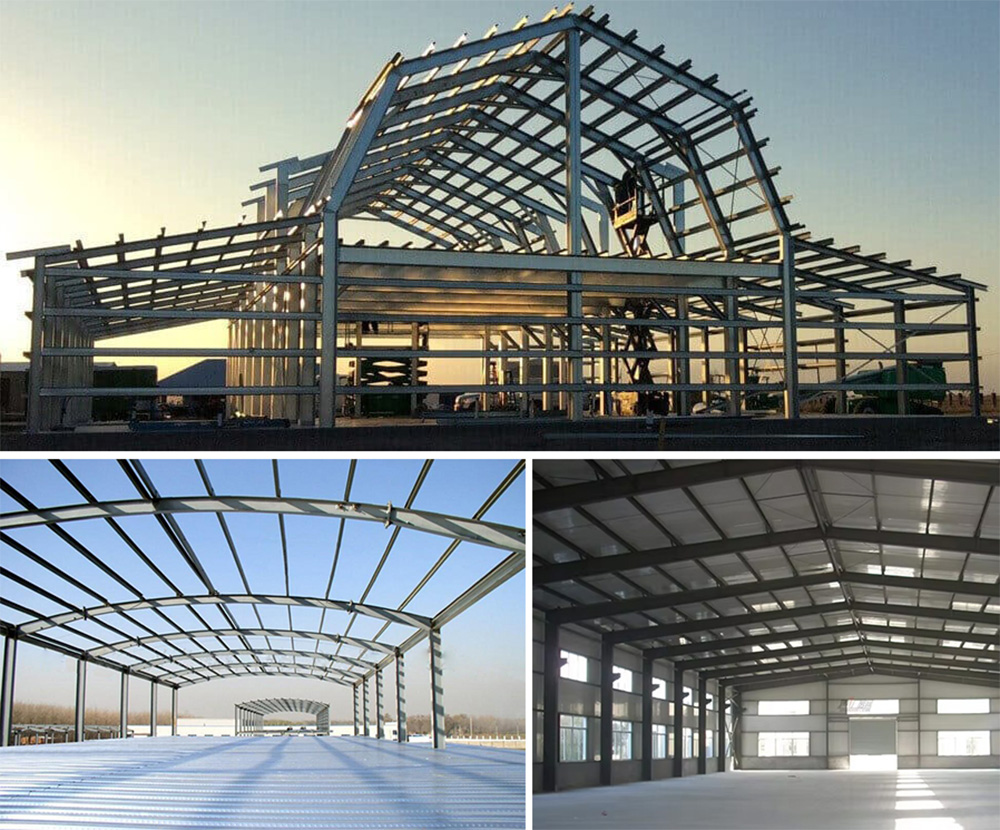
The portal frame is the backbone of most single-storey industrial buildings. Vertical columns rise from the foundation and connect rigidly to sloping rafters, forming a moment-resisting frame that transfers wind and roof loads down to the ground without needing internal load-bearing walls. Because the frame carries the structure, the interior can be left almost entirely open — an advantage that matters when a plant needs to install overhead cranes, long production lines or racking that reaches the eaves.
ZZ Group manufactures the primary frame from H-section steel columns and beams, supplemented by steel pipe and hot-rolled sheet components where the design calls for them. Secondary framing — the bracing system and C or Z shaped steel purlins — ties the frame together and provides the fixing surface for roof and wall cladding. This division between primary and secondary structure is what allows a workshop to be engineered precisely rather than overbuilt, and it is also what makes site assembly so quick: every member arrives cut, drilled and marked for its position.
Materials and Specifications Buyers Should Understand
Steel grade is where a lot of overseas buyers lose money, either by over-specifying and paying for capacity they will never use, or by under-specifying and inheriting a building that struggles under snow or crane loads. ZZ Group works primarily with Q235, Q235B, Q345 and Q345B structural steel. The most widely specified grades are Q235B, equivalent to St37.2, S235JR and ASTM A36, and Q345B, equivalent to St52.3 and S355JR. Q235B covers the majority of general-purpose workshop buildings, while Q345B is typically selected for larger spans, heavier roof loads or frames that will carry crane runway beams.
A steel frame workshop is only as good as the steel in it, which is why grade selection deserves more attention than it usually gets in tender documents.
Dimensions are not drawn from a fixed catalogue. Sizes are produced according to the customer’s requirement, which means span, bay spacing, eave height and roof pitch are all set by the project’s actual use rather than by whatever happens to be in stock. That flexibility is a genuine engineering service, not a sales line, because a workshop sized for pallet racking will fail quickly if the owner later wants to hang a five-tonne crane from the same frame.
Cladding follows the same logic. Roof and wall systems can be built from single colourful corrugated steel sheet, or from sandwich panels with EPS, rock wool, PU or glass wool cores. Single-sheet cladding is the economical option for unheated storage and general manufacturing space. Sandwich panels add thermal insulation, and the choice of core material then becomes a question of fire performance and budget: rock wool and glass wool are the usual answers where fire resistance is specified, while EPS and PU offer strong insulation values at lower cost. In practice, many projects combine the two — insulated panels on walls, single sheet on roofs, or panels only on the elevation that faces the prevailing weather. Either way, the cladding decision is made once at design stage, and it is far cheaper to get it right then than to re-skin a steel workshop building later.
Where These Buildings Perform Best
The two most common structural types ZZ Group supplies are portal structure for single-storey industrial halls and multi-floor frame structure for operations that need vertical space. Both appear across the same broad set of applications. Manufacturing is the largest category, particularly plants handling car parts and machinery, where the open floor plate and high eaves allow heavy equipment to be positioned without obstruction. Logistics and storage follow closely, since a clear-span building can be fitted with high racking and loaded to significant floor pressures.
Food processing and chemical processing facilities also rely on this type of construction, though the cladding specification shifts toward insulated and easily cleaned panel systems. Beyond industry, the same portal frame logic is used for commercial and institutional buildings that need to be delivered on a short programme. The common thread is not the sector but the requirement: a large, strong, column-free envelope that can be erected without a long and weather-dependent site programme. For an operator weighing a steel workshop building against a conventional build, that programme risk is often the deciding factor.
Projects built around metal workshop buildings rarely stop at one structure, either. Sites that start with a single production hall frequently add a second bay, a covered loading area or a separate storage block within a few years, and a steel frame is the only structure that makes those additions straightforward rather than disruptive.
The Advantages, Stated Plainly
The case for a steel frame workshop rests on four properties. Strength comes first — a correctly designed frame carries substantial loads, from roof snow to suspended services to crane operations. Speed is second: because fabrication happens in a factory while site works proceed in parallel, the on-site phase is measured in weeks rather than seasons. Flexibility is third, and it is often underestimated. A steel frame can be extended in bay increments, have openings cut for new doors, or be fitted with a mezzanine without the structural surgery a concrete building would require. Durability is fourth; with appropriate corrosion protection, a steel structure needs very little maintenance over a long service life.
Cost sits behind all four. Factory fabrication, reduced site labour, shorter programmes and less foundation work combine to bring total project cost down, and for buyers comparing quotes the honest comparison is not the price per tonne of steel but the delivered cost of a finished, usable building. That is the argument for a prefab steel structure in one sentence: you pay for a building, not for a construction site.
Choosing a Supplier: What Actually Matters
Workshop buildings are not commodities, and the difference between suppliers shows up in engineering support, documentation and after-sales response. ZZ Group brings a long institutional track record to this market. Founded in the early 1980s and headquartered in Shanghai’s Yangpu District, the group has grown into a large-scale comprehensive enterprise combining steel trade, steel processing and distribution, steel raw materials, real estate development and financial investment, with registered capital of 200 million RMB.
Its operating scale is substantial: more than 20 subsidiary companies and storage facilities across Guangdong, Fuzhou, Xiamen, Chengdu, Chongqing, Shanxi, Tianjin, Liaoning, Lanzhou and Wuxi, six factories, and over 1,500 employees. Annual steel product sales exceed 4.5 million tonnes, with annual sales income above 2.7 billion USD. The company has been recognised as a leading enterprise in China’s metal materials industry, a national steel trade and logistics “Hundred Good Faith Enterprise”, and among the top 100 private enterprises in Shanghai. Its steel trade business acts as agent for major domestic mills including Baosteel, Anshan Steel, Shougang Group, Benxi Steel Group, Hebei Iron & Steel Group, Jiuquan Iron & Steel Group and Liuzhou Iron and Steel, and supplies enterprises such as Gree, Midea, Geely, Volkswagen, XCMG and LONKING.
For buyers of metal workshop buildings, that scale translates into three practical things: material availability at consistent grades, engineering teams who have delivered similar structures before, and the capacity to support a project from design through to expansion.
ZZ Group’s stated operating principle — integrity, practicality, innovation and win-win — is echoed in its approach to project work: supporting customers from the beginning to the end of a project, ensuring workshops are of quality and safe, and assisting with repairs or expansion after handover. Whether that promise holds depends on execution, but the combination of four decades in steel, a processing and distribution network built in-house, and a manufacturing base of six factories is a reasonable basis on which to evaluate a supplier.
Metal workshop buildings work because the portal frame separates what must be strong from what must be fast. The structure is engineered and fabricated to carry the loads, while the cladding and secondary framing are assembled on site with minimal labour — and a prefab steel structure, properly specified, delivers a steel frame workshop that is strong, durable and adaptable at a cost and timeline concrete cannot match. The specification decisions that matter most are steel grade, span and eave height, and cladding core; get those right and the building will serve for decades. Get them wrong and no amount of supplier reputation will compensate. For buyers comparing steel structure workshop suppliers, the sensible test is not who quotes lowest, but who can show the engineering depth, material traceability and delivery record to stand behind a steel structure workshop factory that keeps running long after the ribbon cutting.
Post time: Sep-10-2026


